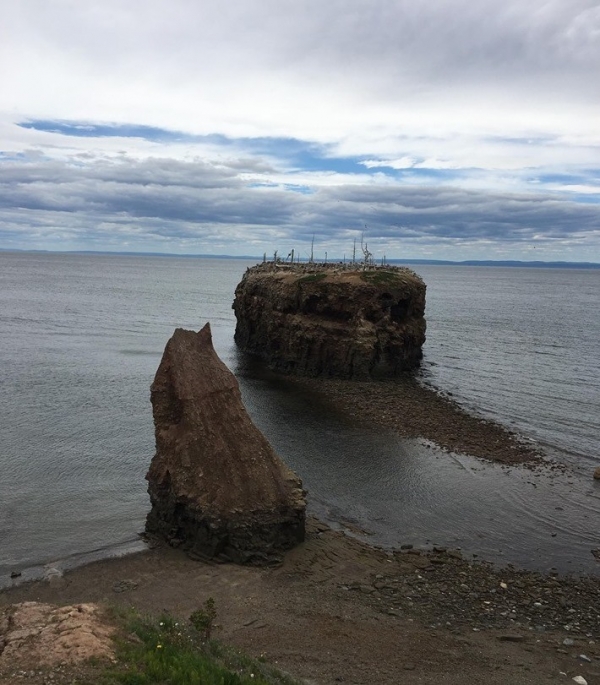
While most of us identify with its island, Pokeshaw is much more than that. It is first and foremost an Irish community west of Grande-Anse, dating back to the 1820s. However, it wasn’t until 1837 that they received their first land grant. Most of the residents are originally from County Cork, Ireland, and since then, along with Black Rock, they have formed two small villages that identify as much with the Acadian Peninsula as the other Acadian communities that comprise it. Like all coastal inhabitants, lobster fishing is important to the community, but it’s noticeable that they have maintained a much more intensive agricultural activity than the rest of the Peninsula. The people of Pokeshaw actively participate in the parish life of Saint-Simon and Saint-Judes Parish in Grande-Anse. The majority of Pokeshaw families deliberately choose to send their children to the school in Grande-Anse, a sign of mutual respect between the Irish and Acadian communities in the region. As early as the beginning of the 1900s, Thomas Riordon studied at the Caraquet College. In recent years, Pokeshaw has seen the return of expatriate villagers, who have given the community a renewed sense of youth and openness. The park overlooking the rock is worth a visit in itself, and the beach at its base needs no introduction. But above all, don’t hesitate to cross the road to Black Rock to admire the Riordon family’s cultivated land, and especially the family home built in 1895 by carpenter Joseph O. Blanchard.
I invite you to explore the settlement of the same name west of Black Rock, where, during the Great Depression, residents of Saint-Léolin tried to settle, but without much success. My childhood memories take me back to the walks my father and I used to take in this ghost town, where abandoned houses still stood.
Bernard Thériault, historian