👤 Joseph-Marie Paquet
Born in Quebec City (Saint-Roch parish) on November 21, 1804, Joseph-Marie Paquet had a difficult childhood: his mother was often ill, and his father, described by Bishop Octave Plessis as a “brutal, jealous, and drunken man,” behaved in a way that distanced him from his paternal responsibilities. He found solace with his maternal uncle, Father Antoine Gagnon, who sent him to the Quebec Seminary, where Paquet completed his classical studies in 1825 and his theological studies in 1828, the year of his ordination.
In 1829, he was sent on a mission to Acadia, New Brunswick, specifically to Shemogue, where he received a mixed reception. He was then appointed to Richibouctou-Village, and in 1840 to Saint-Louis (Kent County). But it was in Caraquet, beginning in 1848, that he would leave his greatest mark. He launched an ambitious project: the construction of a large stone church. Work began in 1857, and the Church of Saint-Pierre-aux-Liens was consecrated in August 1864, before a crowd estimated at 3,000 people. His legacy did not end there. He convinced the Religious Hospitallers of Saint Joseph to settle in Tracadie, a neighbouring parish, to establish a lazaretto. Their arrival in September 1868 marked a turning point in the care of the sick, with the creation of a hospital a few years later. 2
Weakened in 1868, he was admitted to the Hôtel-Dieu de Montréal, run by the same nuns, where he died on July 27, 1869, at the age of 64. His remains were transported to Quebec City aboard the steamship Le Québec for a funeral in his native parish, and then to Caraquet aboard the ship Le Secret, in accordance with his wishes. On August 13, a grand funeral service was held in the presence of the Bishop of Chatham, Bishop James Rogers, and numerous dignitaries. His body was placed beneath the altar of the church he had built, on the Epistle side.
1 Régis Brun, Joseph-Marie Paquet, Dictionnaire biographie du Canada, vol. 9, p. 615.
2 Philippe Basque, Le Grand Vicaire Paquet, SHND, vol. XLVI, no. 2, October 2017, p. 67-96.
In her honor, the village of Paquetville was founded in 1873, 20 km southwest of Caraquet. It is also the birthplace of the artist Edith Butler. Her generous will notably provided for the construction of a convent for young women run by the nuns of the Congregation of Notre-Dame de Montréal, which opened in September 1874.
👤 Mgr Joseph-Théophile Allard
Born in Carleton (Gaspé Peninsula) in 1842, Joseph-Théophile Allard was the son of Pierre Allard and Marie-Gilles Allain. At the age of 12, he entered the Nicolet Seminary, then continued his theological studies at the Grand Séminaire de Québec from 1863. In 1864, he was sent to Memramcook, where Father Camille LeFebvre opened Collège Saint-Joseph. Ordained a priest in 1867, he became the vicar of Father Paquet in Caraquet.
After Paquet’s death, Father Allard was appointed parish priest in Pokemouche-en-Haut, where he remained for seven years. He returned to Caraquet in 1879, but a dispute with the Sisters of Notre-Dame led him to Paquetville, then to Saint-François-de-Madawaska. He returned to Caraquet a third time in 1885 and launched an ambitious project: the construction of a classical college.
Sacred Heart College opened its doors in 1899 with 17 students, including his nephew Auguste Allard, the future founder of Allardville. Run by the Congregation of Jesus and Mary (the Eudists), the college was expanded in 1903 and again in 1907. In 1906, the Eudists petitioned the Vatican to have Father Allard appointed Apostolic Protonotary. This was accomplished that same year during a grand ceremony in the parish church, where he became Monsignor.
Operated on at the Hôtel-Dieu de Québec, he died on January 30, 1912. His funeral was held on February 7, and his remains were laid to rest beneath the altar of the church in Caraquet. Like his predecessor, he requested in his will the removal of his heart, which was placed in a reliquary in the college chapel. Note: Father Paquet had expressed the same wish, his heart being kept in a lead casket in the chapel of the Hôtel-Dieu de Tracadie. 3
⚰️ Translation of the remains
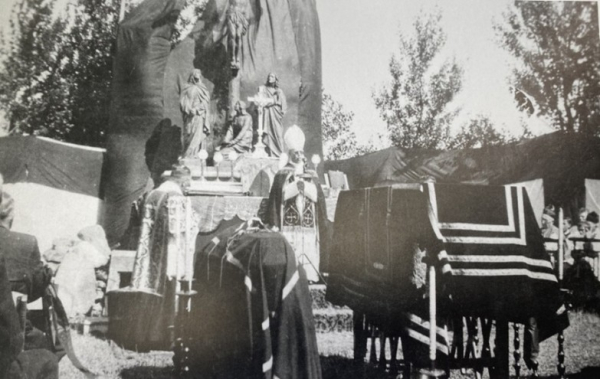
On August 22, 1944, the remains of the two priests were exhumed from the church sanctuary and reinterred in the local cemetery. A pontifical mass was celebrated by Bishop Camille-André LeBlanc of Bathurst before an assembly of clergy, dignitaries, and parishioners. The coffins were draped and carried beneath the Calvary cross, where they now rest in the crypt.
“After the mass, the Bishop approached the microphone, and there, moved by the crowd and undoubtedly inspired by the sight of the remains of these two great Acadian apostles, he gave us a touching summary of what these two priests had accomplished.”
In the commemorative photograph, on the left is the small coffin of Bishop Paquet, fitted with a viewing window over his face, and on the right is that of Bishop Allard. 4
🕊️ Heritage
Arriving from Quebec at a time when Acadia was experiencing difficult times, Bishop Paquet and Bishop Allard shaped the identity and development of Caraquet. Their memory continues to inhabit the place and the hearts of its people.
3 Clarence LeBreton. Le collège Sacré-Cœur de Caraquet, Éditions du Fleuve, Quebec, 1991.
4 L’Évangéline, August 31, 1944, p. 1.